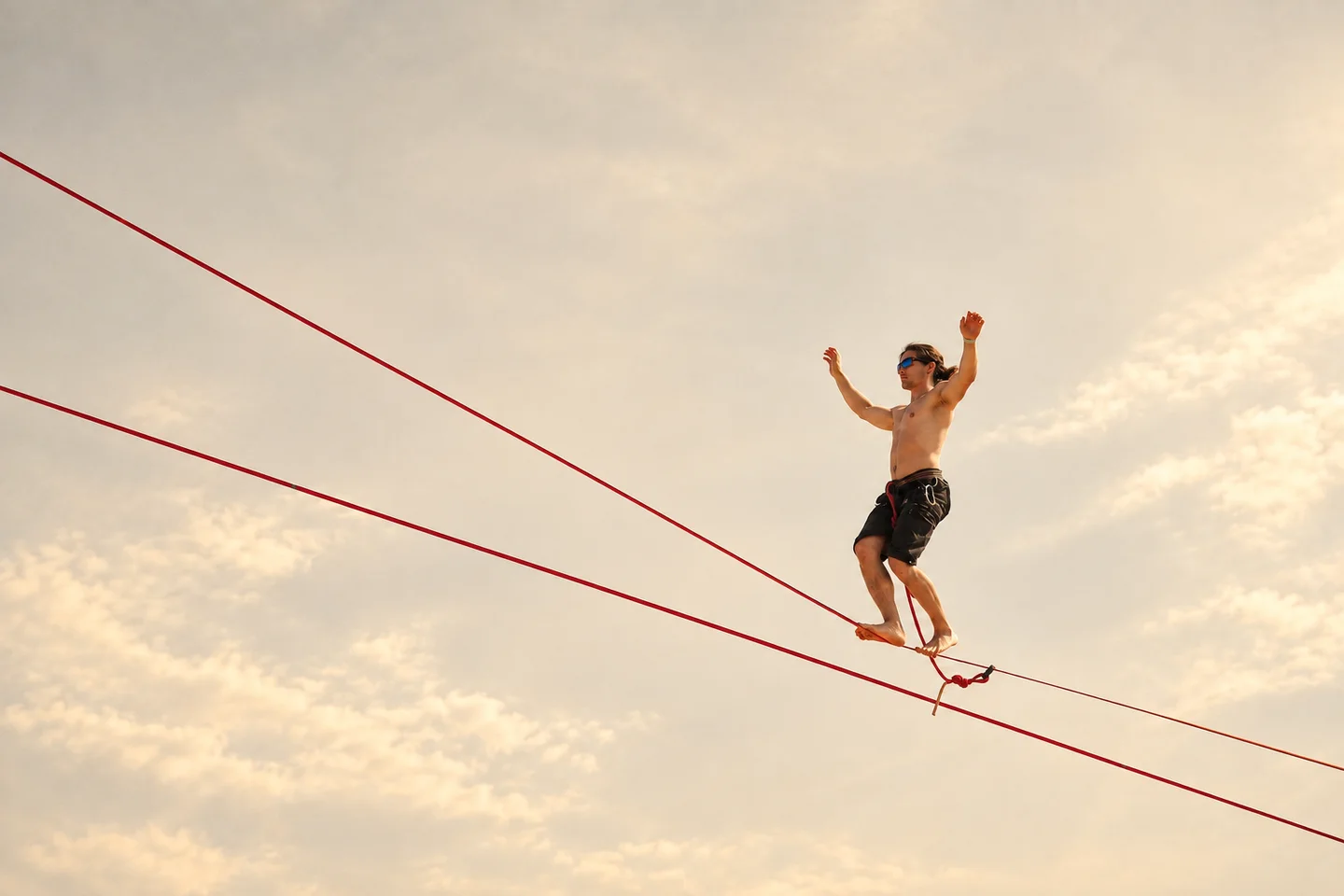
Try standing on one leg for 30 seconds. It is a useful test of balance. But now imagine stepping around a chair while carrying a bag, turning to answer someone, or catching yourself after a misstep. Those moments ask for something more: dynamic balance, the ability to stay in control while your body is moving.
Static balance helps you hold a position. Dynamic balance helps you move from one position to the next. Daily life calls on both, but it rarely asks us to stand perfectly still. We shift weight, change direction, reach, turn, and step over obstacles. If we want to feel more capable in those situations, we need to practice balance through movement.
Balance takes strength, awareness, and coordination
Dynamic balance is not just a matter of “having a good core.” Your muscles must support your weight, control a movement, and help you adjust as your position changes.
Your feet and lower legs make small corrections against the ground. The calf muscles help control motion at the ankle, while muscles along the front of the shin help position the foot as you step. Your thighs support and control the knee as you lower into a stance or rise out of one. Your glutes and other hip muscles help steady the pelvis when your weight moves onto one leg and help control side-to-side movement. Your trunk muscles help keep your upper body organized over that changing base of support. Research on walking balance identifies contributions from the ankle, thigh, and hip muscles; a review of hip muscle research also found that strength in the muscles at the sides of the hips matters for balance and mobility. Read more about muscle contributions to dynamic balance.
Strength alone is not the whole skill. Balance also depends on using the right muscles at the right time. You need enough control to shift weight smoothly and enough strength to support yourself when a step, turn, or change of level becomes more demanding.
In addition to strength and muscular coordination, your brain also needs information about where you are. Proprioception is your sense of the position and movement of your joints and limbs. Your vestibular system, located in the inner ear, helps detect head movement and orientation. Vision provides another source of information about your surroundings. Your brain combines these signals and adjusts how much it relies on each one as conditions change. A 2025 study of younger and older adults illustrates that partnership. Other studies show that with practice, your nervous system can get better at detecting movement, judging joint position, and choosing which sensory signals to rely on.
Both Tai Chi and Shaolin Kung Fu practice coordinating sensory information with movement, helping to improve your overall capability.
Tai Chi: control in every transition
Tai Chi’s slow pace gives you time to notice what happens between movements. As you shift weight from one foot to the other, turn your body, and step into a new position, your legs and hips work to support you while your trunk stays organized. The challenge is subtle: can you move smoothly while remaining aware of where your weight is?
Research supports Tai Chi as a way to develop balance. A review of 18 randomized trials found improvements in both static and dynamic balance among older adults. Another review found improvements in some measures of lower-limb strength. Results vary by study and by the strength measure used, but Tai Chi gives students repeated practice in controlling their weight through movement.
Shaolin Kung Fu: strength that responds
Shaolin Kung Fu brings a different pace and range of demands. Its training can combine stances with stepping, turning, changing levels, and coordinated arm and leg movements. Holding a stance asks the legs and hips to support the body. Moving out of it asks those muscles to control the transition and prepare for the next position.
Research on Shaolin Kung Fu specifically is limited, but studies of other standing martial arts offer useful context. In one study, older adults improved on tests of dynamic balance after five weeks of martial arts training. Another study found improvements in several balance measures among adults over 40. A review of combat sport studies also reported balance improvements in older adults who trained in standing martial arts.
Combined, those studies suggest Shaolin Kung Fu’s combination of leg strength, weight shifts, steps, kicks and changes of direction is relevant to balance training.
Build balance you can use
Static standing balance has a place in training. It builds awareness and control. The next step is to carry those qualities into motion.
Tai Chi offers a patient way to practice that skill through continuous weight shifts and steps. Shaolin Kung Fu challenges it through a wider variety of stances and movements. Both ask your feet, legs, hips, and trunk to work together as you move.
Balance is more than the ability to stay still. It is the strength and coordination to keep going.