
Say the word chi—or qi—and people tend to picture one of two very different things.
For some, qi is a working concept from Chinese medicine, Qigong, Tai Chi, and traditional martial arts: something experienced through breath, movement, intention, and the way the body organizes itself. For others, the word immediately conjures people being knocked across rooms without being touched, invisible energy balls, or supernatural powers.
Those are not the same claim, and it’s worth being honest about that from the start.
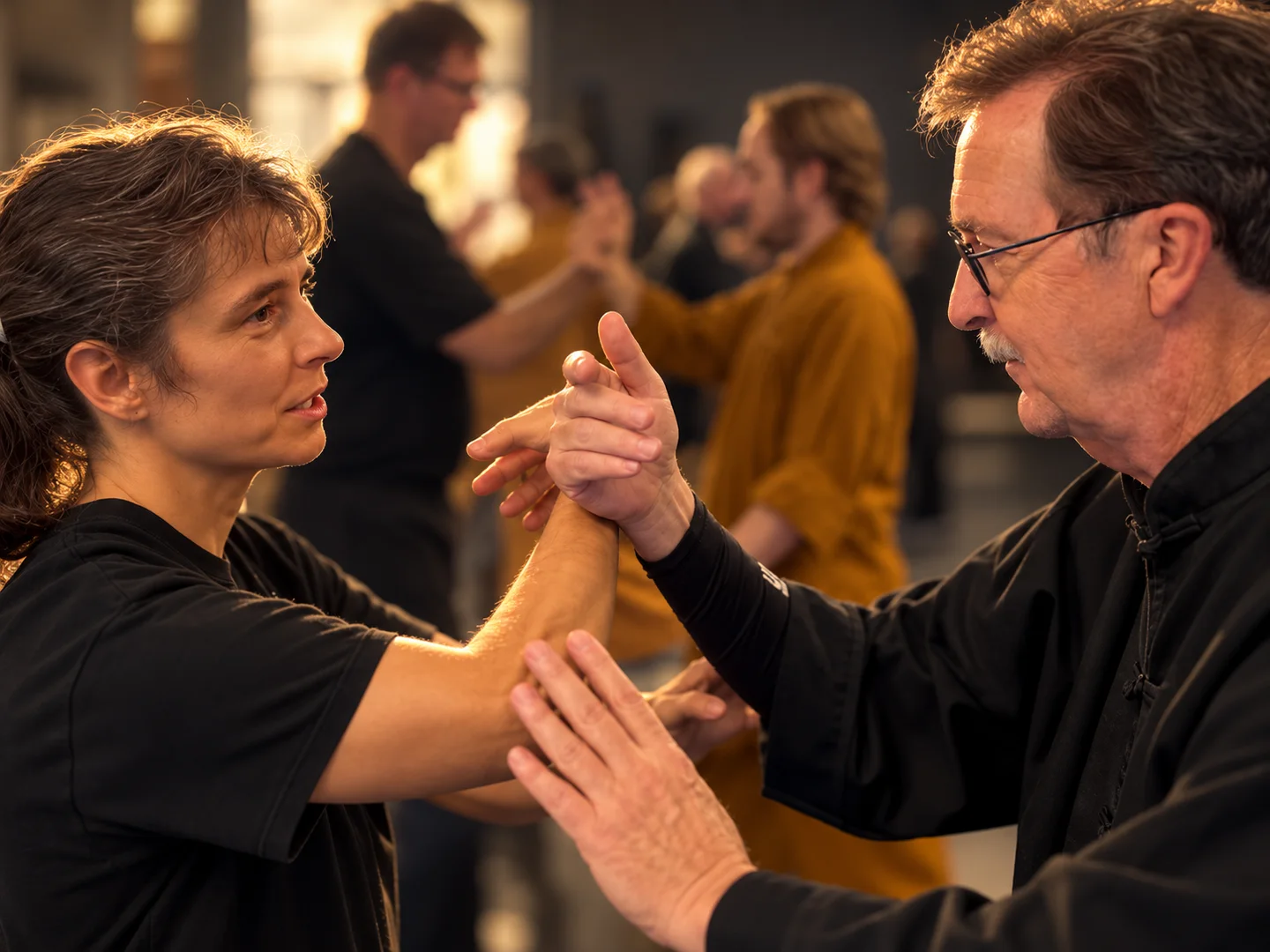
At Shaolin Arts, when we talk about chi, we are not talking about projecting an invisible force across a room. In our training, chi is expressed through the body. It accompanies movement. It is related to structure, breathing, intention, connection, and the transmission of force from one person to another through contact.
That last point is central to how we understand the subject, so we will state it plainly: we believe the expression of qi always has a kinetic component, and that physically moving another person requires contact with them. We do not believe you can physically move someone with qi alone, without touching them.
But many experienced practitioners will also tell you something else: there seems to be more going on than simply contracting muscles.
That raises a genuinely interesting question. What, if anything, is modern science beginning to tell us about qi?
The honest answer isn’t that science has discovered some mysterious new energy called chi. But it’s also not as simple as saying ancient practitioners were just describing muscle activity with primitive vocabulary. Modern research is starting to reveal a body that is far more interconnected, electrically active, mechanically integrated, and responsive to intention than the simple mechanical model most of us learned in school. That makes the question a lot more interesting than either side of the usual argument admits.
First, What Do We Mean by Qi?
Part of what makes this hard to discuss scientifically is that qi has never had one narrow meaning the way a volt, a joule, or a newton does. Depending on context, classical Chinese sources use the concept in connection with breath, vitality, movement, internal function, environmental processes, and the organization of living systems generally.
Martial artists encounter qi experientially, not as a definition. A movement that initially takes obvious muscular effort can eventually become connected, relaxed, and powerful. Intent seems to precede movement. Force can travel from the ground, through the legs and torso, and out through the hands. With a partner, very small changes in tension, direction, pressure, or structure can produce surprisingly large effects.
Notice what all of those experiences have in common: they involve movement, and when another person is affected, they involve contact. In our tradition, the expression of qi is never separate from motion. We aren’t saying qi is itself a form of movement; as we discuss later, it may be better understood as something underlying, such as the integrated state and activity of the living body. But what shows up, what can be felt, trained, and tested, shows up in how the body moves and in how force travels through the body and into a partner.
Traditional Chinese martial arts built a vocabulary for describing these experiences long before electromyography, brain imaging, force plates, cellular electrophysiology, or modern connective-tissue research existed. The mistake would be assuming the traditional vocabulary and the scientific vocabulary must describe exactly the same things. The equally serious mistake would be assuming that because ancient practitioners lacked modern scientific terminology, they therefore observed nothing real.
The Mechanical Part Is Real
Some phenomena associated with internal martial arts are readily explainable through straightforward biomechanics.
When a person generates force efficiently, the body doesn’t operate as a collection of isolated muscles. Force emerges through coordinated interaction among the feet, legs, pelvis, trunk, shoulder girdle, and arms. Posture matters. Timing matters. Joint alignment matters. Ground reaction forces matter. Breathing and internal pressure matter. Unnecessary muscular tension can actually interfere with movement rather than improve it. None of that requires a mysterious force to explain.
But saying biomechanics accounts for part of what practitioners experience doesn’t mean biomechanics, narrowly understood, accounts for all of it. That distinction has started showing up in serious Tai Chi and Qigong research.
In 2025, an international group of researchers published a major two-part review titled The Science of Tai Chi and Qigong as Whole Person Health, the product of a conference hosted by the Osher Center for Integrative Health at Harvard Medical School, with investigators from Harvard, UCLA, Massachusetts General Hospital, Tufts, the University of California system, and other institutions. Rather than treating Tai Chi and Qigong as forms of light exercise, the authors examined them as complex practices with interconnected effects across biomechanics, brain function, autonomic regulation, cognition, immune function, inflammation, and body awareness [1].
That “whole person” framing may turn out to be especially useful for understanding traditional concepts like qi.
The Body Is More Connected Than It Looks
One particularly interesting area is fascia, the connective tissue that forms an extensive three-dimensional network throughout the body, surrounding and penetrating muscles, connecting structures, transmitting mechanical forces, containing sensory receptors, and participating in cellular signaling.
Modern anatomy increasingly recognizes that muscles don’t function as fully isolated units. A systematic review of myofascial chains found anatomical evidence that many muscles are directly linked by connective tissue, supporting the idea that force can transmit across much larger regions of the body than a single-muscle model would predict [2]. That matters to martial artists. Anyone who has trained whole-body power knows the difference between moving an arm independently and connecting a movement through the entire body.
There’s also a striking connection to traditional Chinese ideas about channels, or meridians. Researchers at the University of Vermont and elsewhere examined acupuncture locations in anatomical sections and reported that roughly 80 percent of the points they studied corresponded with intermuscular or intramuscular connective-tissue planes, proposing that connective tissue could play an integrative role in phenomena traditionally associated with acupuncture meridians [3]. Other researchers have gone further, proposing that the fascial network might constitute at least part of the anatomical substrate represented by the traditional meridian system [4]. That remains a hypothesis rather than an established identification, but it is a scientifically testable one, not mystical speculation.
None of this means fascia is qi. It means traditional practitioners may have recognized patterns of body-wide connection long before anatomy had language to describe them.
Movement Changes Biology
Fascia also turns out not to be passive packaging. Mechanical forces applied to tissue can produce cellular responses through a process called mechanotransduction. Stretch, pressure, shear, and tension can influence cellular activity, signaling pathways, tissue remodeling, and inflammatory responses.
In other words, movement isn’t merely something the body does. Movement becomes information the body responds to.
That offers one intriguing modern framework for a traditional martial-arts idea: correctly organized movement can produce effects that propagate through an interconnected organism, rather than staying local to the muscle doing the work. We shouldn’t simply rename mechanotransduction “qi,” but the correspondence is worth taking seriously. It is also, notably, a framework built entirely on mechanical input: force, tension, pressure, and movement. That fits our understanding that qi is expressed through physical, kinetic means.
Intent Is Physical, Too
Internal martial arts place enormous emphasis on yi, or intention. A beginner typically thinks, “I move my arm.” With deeper training, the process gets subtler: attention, intention, pressure, timing, relaxation, and whole-body organization all begin to interact.
Modern neuroscience gives us good reason to take intention seriously as a physiological variable, not just a mental one. Imagining movement activates parts of the motor system. Motor imagery can alter neural pathways involved in actual movement. Attention changes sensory processing. Training changes how the brain integrates proprioceptive information, the ongoing sense of where the body is and how it’s moving.
Tai Chi research increasingly examines effects on motor control, cognition, interoception, balance, sensory integration, and brain connectivity. The 2025 Harvard-associated review describes Tai Chi and Qigong not as single-component exercises but as multimodal practices that simultaneously engage attention, movement, breathing, sensory awareness, and regulation of physiological systems [1].
The traditional statement that “intent leads movement” doesn’t require magic to be true. Intent already changes the physical organism. But notice the wording: intent leads movement. It directs the body’s movement. It does not replace it.
The Body Is Also Electrical
Here the subject gets even more interesting.
Most of us learned that the body’s electrical activity means nerves sending impulses and the heart generating an electrical rhythm. That’s true, but incomplete. Every living cell maintains an electrical potential across its membrane. Ion channels regulate the movement of charged particles across that membrane. Electrical gradients influence cellular behavior, and cells communicate through mechanisms that include electrical as well as chemical signaling.
A growing field of research examines bioelectricity not simply as a byproduct of life, but as part of the information system through which cells coordinate growth, development, repair, and tissue organization.
That doesn’t mean qi is electricity. There is currently no scientific basis for making that equation. But it does mean living bodies contain distributed electrical signaling systems considerably more sophisticated than the “nerves are wires” model most of us grew up with. The old idea that the organism has body-wide regulatory activity no longer sounds inherently irrational just because ancient practitioners lacked the word bioelectricity.
Living Things Even Emit Light
This is perhaps the strangest established phenomenon in this whole discussion: living cells emit photons.
The phenomenon is called ultraweak photon emission, sometimes popularly known as biophoton emission. These emissions are extraordinarily faint, associated primarily with oxidative metabolic processes involving reactive molecular species. They are real and measurable. A 2024 review in Frontiers in Physiology describes advances in detector technology that are increasingly allowing researchers to measure and image these emissions and investigate whether they carry biological or medical significance [5].
Does that mean the glow sometimes described in traditional accounts of qi has been scientifically verified? No. Does it mean humans literally emit measurable electromagnetic radiation as part of normal biology? Yes.
That distinction captures much of what makes this area fascinating. Science keeps discovering phenomena that would have sounded strange before we built instruments capable of detecting them. That’s not evidence every traditional claim is correct, but it is a good reason for humility.
What About a Biofield?
This brings us to the most controversial question: could organisms produce some kind of biologically meaningful field beyond the electrical activity we already understand?
Researchers sometimes use the term biofield as an umbrella concept for proposed field-like interactions associated with living organisms. The evidence here is far less settled than in the areas above. A 2025 scoping review identified 353 human studies investigating various so-called biofield therapies, including Reiki, Therapeutic Touch, Healing Touch, external Qigong, and related practices. The literature contains positive, mixed, and negative results, with substantial variation in study quality, methods, and interventions, and external Qigong accounted for only 16 of those 353 studies [6]. That body of research establishes something important: scientists have actually investigated these questions. It does not establish the existence of an unknown energy field.
One especially intriguing experiment was published in Scientific Reports in December 2024. Researchers conducted 60 treatment and control sessions in which a practitioner attempted a non-contact “biofield” intervention from about 12 inches away, directed at cultured pancreatic cancer cells. The experiment used double-blind conditions and simultaneously measured cellular variables and the practitioner’s own physiological activity. The investigators reported a statistically significant difference in calcium uptake between treatment and sham conditions, and found unusual statistical associations between the practitioner’s EEG activity and the cellular measurements [7].
Those results are interesting. They are not proof. It was essentially a highly unusual case study involving one practitioner, and the researchers themselves said follow-up investigation is necessary. An extraordinary finding requires replication by independent labs before strong conclusions are justified. That’s exactly how science should work: an unexpected result should be neither immediately dismissed nor immediately converted into belief. It should be tested again.
It is also important to be clear about what this kind of research would and would not mean, even if it were eventually replicated. A measurable effect on cultured cells in a laboratory dish is a very different thing from physically moving a human being. Nothing in this literature suggests that one person can push, throw, or knock down another without touching them, and that is not a claim we make.
And Then There Are Biophotons, Again
Researchers are also exploring whether ultraweak photon emissions might someday help explain forms of biological signaling we don’t currently understand. A 2025 review in the journal Explore examined proposed mechanisms involving ultraweak photons, electromagnetic processes, and other biophysical effects in relation to so-called energy-based interventions. The paper discusses possible mechanisms but presents them explicitly as emerging hypotheses, not established explanations [8].
This is exactly where language needs to be careful. The existence of ultraweak photon emission is well established. The idea that these photons allow meaningful communication between two people is not established. The first fact does not prove the second, no matter how tempting the leap is.
So Has Science Discovered Qi?
No.
There is currently no instrument a practitioner can point at a person and say, “There, that measurement is qi.” No universally accepted physical quantity corresponds to qi. No reproducible experiment has established qi as a distinct fundamental force. And claims that someone can project qi across a room and physically knock another person down without conventional contact force have not been demonstrated under the kind of controlled conditions that would justify accepting them scientifically.
Those limitations matter. Traditional martial arts damage their own credibility when they claim more than the evidence supports.
But the opposite claim, that modern science has demonstrated there can be nothing corresponding to qi, is also stronger than the evidence allows.
What science has actually discovered is something subtler: the human organism contains overlapping networks of mechanical force transmission, connective tissue, neural signaling, proprioception, interoception, respiration, autonomic regulation, blood and fluid dynamics, cellular mechanotransduction, biochemical signaling, bioelectrical signaling, electromagnetic activity, and ultraweak photon emission, and all of these systems interact continuously. That picture looks much less like a machine assembled from independent parts and much more like an integrated, continuously communicating organism. That distinction matters more than it might first appear.
Where We Draw the Line: Qi Is Expressed Kinetically, and Moving Another Person Requires Contact
Because this subject attracts so much confusion, we want to be specific about our own position.
At Shaolin Arts, we believe the expression of qi always has a kinetic component. To be precise, we are not claiming that qi is itself motion or force. What qi is remains an open question, and we discuss some possibilities below. Our claim is about how it shows up: through force rising from the ground through the legs, through the turning of the torso, through the travel of force along a connected body. Take away the movement, and there is nothing to observe, feel, or train.
We also believe that physically affecting another person requires contact. When one person moves another, force has to pass from one body to the other, and that happens through touch: a hand on an arm, a forearm against a wrist, a shoulder against a chest. Everything that is genuinely transmitted in a push, a redirection, a throw, or a Tai Chi push-hands exchange is transmitted through that contact. This is why so much of traditional training, including the sensitivity practices known in Chinese as ting jin, or “listening,” is built on contact between partners. The contact is not incidental to the skill. It is where the skill lives.
So we do not teach, and we do not believe, that a person can move or damage another person from a distance using qi alone. We are not claiming that the phenomenon exists but is rare or difficult. Our position is that it is not how the art works.
That position is not a retreat from the tradition. It is a statement of what we have found the tradition to be: a deeply practical body of knowledge about how force is generated, connected, transmitted, and received through physical contact. The subtlety is real. The range of what skilled practitioners can do with a very small amount of visible effort is real. But all of it is physical, kinetic, and in contact.
Maybe Qi Is a Systems-Level Concept
There’s another possibility worth taking seriously: that asking “what substance is qi?” starts with the wrong kind of question.
We don’t ask what substance “balance” is. Balance emerges from interaction among the vestibular system, vision, proprioception, muscular activity, reflexes, attention, prediction, and movement. We don’t ask what substance “coordination” is, either. Coordination describes an organized relationship among many physical systems, not a thing you could isolate in a jar.
Qi might be similar: a traditional systems-level concept, a way of talking about the integrated state and activity of the living organism, rather than a single substance waiting to be discovered. If so, modern science may eventually explain many components of what traditional practitioners called qi without ever finding a particle named qi, and that wouldn’t necessarily mean the old concept was wrong. It might mean the traditional and scientific languages are operating at different levels of description.
Consider temperature. People understood that objects could be hotter or colder thousands of years before anyone understood molecular kinetic energy. Their experience of heat was real; their explanatory models varied widely. The later discovery of molecular motion didn’t make the original experience imaginary. It gave us a more precise account of what was contributing to it. Qi may, or may not, turn out to be something like that. We simply don’t know yet.
What We Experience in Training
There’s another kind of evidence that deserves respect without being confused with laboratory evidence: experience itself.
People who practice Tai Chi, Qigong, and traditional martial arts for years frequently report sensations of warmth, pressure, fullness, heaviness, lightness, expansion, connection, flow, tingling, and changes in how force moves through the body. Those sensations are real experiences. Their interpretation is a separate question.
A sensation may involve attention, circulation, nerve activity, changes in muscle tone, fascial tension, autonomic response, interoception, expectation, or some combination of mechanisms we don’t fully understand yet. Calling the sensation imaginary simply because its mechanism is uncertain would be poor science. Calling it proof of an invisible energy field would also be poor science. The appropriate response, in both directions, is curiosity rather than certainty.
Our Approach at Shaolin Arts
At Shaolin Arts, chi is not taught as a supernatural weapon. We do not teach students to stand across the room and throw invisible balls of energy at one another, and we do not believe it can be done.
Chi is encountered through training: through breathing, through intent, through structure, through relaxation, through movement, through connection with the ground, through contact with another person’s body, through learning when to be full and when to be empty, through learning how force can travel through a connected body rather than being generated by isolated muscular effort.
In our understanding, the expression of chi is always kinetic. It shows up in movement, and when it affects another person, it does so through physical contact. That is what makes it something that can be trained, tested, and refined with a partner, rather than merely claimed.
We also recognize something experienced practitioners have recognized for generations: sometimes the experience seems richer than the mechanical explanation covers. We’re comfortable leaving that question open rather than forcing an answer either way. Leaving the mechanism open is not the same as leaving the method open. Whatever chi ultimately turns out to be, we know how we train it: in motion, and in contact.
Traditional Chinese martial arts developed through centuries of close observation of the human body from the inside, through repeated practice, partner contact, breath, pressure, movement, and attention. Modern science observes the body through a different set of tools: force plates, MRI, EEG, electromyography, microscopy, cellular electrophysiology, photon detectors. Neither approach requires abandoning curiosity about the other.
The Most Scientific Answer May Be: We Don’t Know Yet
Skepticism is useful. So is openness. Good science requires both. We should be skeptical of extraordinary claims when the evidence is poor, and equally skeptical of the assumption that everything worth knowing about the living body has already been explained.
In 2026, Harvard Medical School’s Osher Center convened another international conference devoted to the science of Tai Chi and Qigong. One of its four major themes was titled “Research at the Frontier: Fascia, Energy and Sensation” [9]. That title is significant on its own. Researchers aren’t announcing they’ve found qi. They’re acknowledging that questions about fascia, sensation, energetic experience, and whole-body regulation are scientifically interesting enough to keep investigating.
That’s exactly where we think the subject belongs. Not in blind belief. Not in reflexive ridicule. In practice, in observation, in experiment, in careful language, and in the willingness to admit some questions remain open.
Perhaps someday everything martial artists describe as qi will be fully explained through biomechanics, neuroscience, connective tissue, bioelectricity, and other known biological processes. Perhaps science will discover mechanisms we don’t currently recognize. Either outcome would be interesting.
Until then, we’ll keep doing what traditional martial artists have always done: train, observe, test, and refine, in motion, and in contact.
Sources
- Wayne, P. M., Ahn, A., et al. (2025). The Science of Tai Chi and Qigong as Whole Person Health—Part I: Rationale and State of the Science. Journal of Integrative and Complementary Medicine, 31(6), 499–520. https://doi.org/10.1089/jicm.2024.0957. Yeh, G. Y., Ahn, A., et al. (2025). Part II: Evidence Gaps and Opportunities for Future Research and Implementation. Journal of Integrative and Complementary Medicine, 31(6), 521–534. https://doi.org/10.1089/jicm.2024.0958.
- Wilke, J., Krause, F., Vogt, L., & Banzer, W. (2016). What Is Evidence-Based About Myofascial Chains: A Systematic Review. Archives of Physical Medicine and Rehabilitation, 97(3), 454–461. https://doi.org/10.1016/j.apmr.2015.07.023.
- Langevin, H. M., & Yandow, J. A. (2002). Relationship of Acupuncture Points and Meridians to Connective Tissue Planes. The Anatomical Record, 269(6), 257–265. https://doi.org/10.1002/ar.10185.
- Bai, Y., Wang, J., Wu, J.-P., et al. (2011). Review of Evidence Suggesting That the Fascia Network Could Be the Anatomical Basis for Acupoints and Meridians in the Human Body. Evidence-Based Complementary and Alternative Medicine, 2011, 260510. https://doi.org/10.1155/2011/260510.
- Mould, R. R., Mackenzie, A. M., Kalampouka, I., et al. (2024). Ultra Weak Photon Emission—A Brief Review. Frontiers in Physiology, 15, 1348915. https://doi.org/10.3389/fphys.2024.1348915.
- Sprengel, M. L., Teo, L., Allen, S., et al. (2025). Biofield Therapies Clinical Research Landscape: A Scoping Review and Interactive Evidence Map. Journal of Integrative and Complementary Medicine, 31(5), 406–430. https://doi.org/10.1089/jicm.2024.0773.
- Cohen, L., Delorme, A., Cusimano, A., et al. (2024). Examining the Effects of Biofield Therapy Through Simultaneous Assessment of Electrophysiological and Cellular Outcomes. Scientific Reports, 14, 29221. https://doi.org/10.1038/s41598-024-79617-3.
- Sá, R., & Pignataro Neto, G. (2025). Advancing Biophysics in Energy-Based Clinical Interventions: A Narrative Review. Explore, 21(4), 103198. https://doi.org/10.1016/j.explore.2025.103198.
- The Science of Tai Chi and Qigong as Whole Person Health, April 30–May 1, 2026, Harvard Medical School, Boston, MA. (2026). Conference abstracts and proceedings, including “Research at the Frontier: Fascia, Energy and Sensation.” https://doi.org/10.1177/27536130261456353.